On the island
10/10/25 00:43
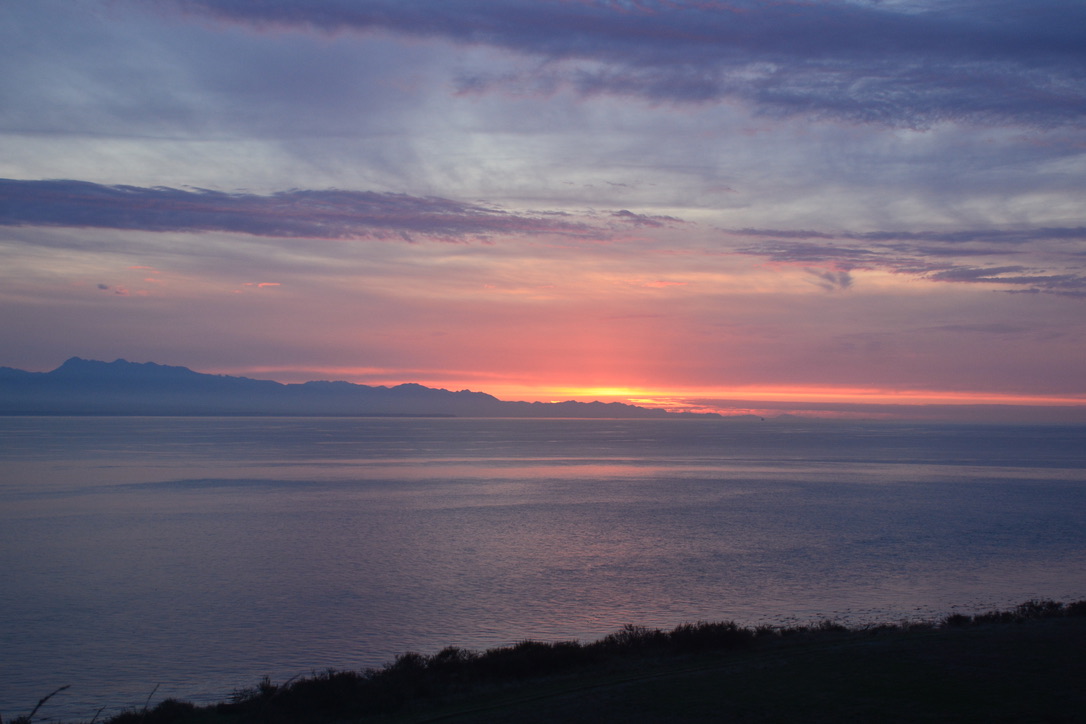
Being retired and living in a place with a mild climate results in an extended camping season. One of the things we intended to do as soon as we retired is to explore the state parks that are close to our home. Now we’ve been retired for five years, and we are just getting around to some of those explorations. Yesterday and today, we’re on a quick explore of Fort Ebey State Park. We are on Whidbey Island. We got here by driving across a bridge to Fildago Island and then crossing another bridge, over Deception Pass, onto Whidbey. The southern end of the Island is served by a ferry that goes to Everett. There is also a ferry from Coupeville here on the island to Port Townsend at the tip of the Olympic Peninsula.
Whidbey is a large island, about 75 miles north to south. However, here in the middle of the Island, it is very narrow. This afternoon, we climbed up to the top of a bluff where we could see both sides of the island. Beyond the island, we could see Mount Baker and Mount Rainier in the North Cascades to the east and the mountains of Olympic National Park to the west.
Before it was a state park, Fort Ebey was part of the strategic defense of the United States during World War II. With an unobstructed view of the Pacific to the west of the Olympic Peninsula, guards would be able to detect ships from Japan should they attack. The fort was equipped with large guns, set into concrete bunkers. Some of the places where the guns were located have been preserved.
After the war, the State of Washington obtained part of Fort Ebey and has a campground with beach access and hiking trails along the high bluffs and through some forested areas. I’m sure this campground is full during the summer, but there are many empty camping spaces now. We have a lovely site that offers dramatic views to the west. It was the perfect place to watch the sunset last night.
Fort Ebey got its name from Jacob Ebey, who settled the Island in the middle of the 19th Century. The 1850 Donation Land Claim Act allowed settlers to gain title to farm land, and the Ebey family was successful in proving up several claims in the area.
Ebey’s Landing National Historical Reserve is a one-of-a-kind partnership administered by a trust board comprised of representatives from the National Park Service, Washington State Parks and Recreation, Island County, and the Town of Coupeville. Placing preservation of the land as its highest priority, the trust provides access to a large area of land with hiking trails, campgrounds, and more. The Reserve offers many recreational opportunities and protects farmland from development.
The prairies on Whidbey Island have a long history. In contrast to other islands and coastal areas, Whidbey Island has large areas of productive farmland. Jacob Ebey was reported to have claimed that the Island boasted the best farmland he had ever seen. Although there has been timber harvesting on the Island for many years, there are also large areas that are not as heavily forested. Local tradition and lore explain that the Coast Salish tribes maintained the open prairies long before settlers arrived by setting fire to the land from time to time. The open prairies produced camas, an important part of the Native American diet. The sea provided a rich source of protein with clams, crabs, mussels, and other shellfish easily harvested at low tide. The Coast Salish people also fished from canoes, harvesting salmon, halibut, mackerel, as well as marine mammals. Teams of skilled hunters could feed a community for a long time with a single whale.
Visiting the area when there are fewer tourists allows us to reflect on the many layers of history of this place. During the last ice age, the entire region was covered with huge amounts of ice. As the ice retreated, it scraped out and shaped the coastal areas. The Mountains were also sculpted by the ice, but in the coastal regions, the evidence of the retreating glaciers is visible. The National Historical Reserve has many signs that explain the history and geology of the region. Part of the reserve is the preservation of working farms. The combination of history and ongoing agriculture makes the reserve a fascinating place to visit.
We enjoyed a quiet evening, watching the sun set. The quiet was a special treat because Ebey’s Landing National Historical Reserve is right next to Whidbey Naval Air Station. Jet aircraft do fly over the area at all hours. However, activity at the NAS has been low during our visit and we have enjoyed the absence of the roar of afterburners.
The two of us are very comfortable in our little camper, and even though we are retired, we find joy in getting away from home and our usual routine. We have more time to hike and talk.
We live in a time of so many crises. The climate crisis is real, and action is required from the grassroots level to international diplomacy. The minority takeover of the federal government by those with the intent of establishing an authoritarian state demands that we participate in active resistance. Public attacks against our neighbors of different faiths and different ethnic backgrounds combine with attacks against gay, lesbian, bisexual, and transgender persons, and we feel compelled to stand with them. It sometimes seems as if we need to live in a state of constant vigilance and can never let our guard down.
In these times, it is important that we take time to be in nature. I suppose that these journeys have a self-care function. But self-care is not the primary reason we keep returning to experiences in nature. We come to keep ourselves connected to the natural world as a source of wisdom and discernment. If we are to remain faithful to our responses to the crises the world is facing, we need to remain in the struggle for the long haul. We dare not burn out or become disconnected. Regular visits to places of natural beauty are critical for reminding us why our actions are important. Strength for the battle comes from the places of vision.