Animal sightings
03/05/24 02:14
One of the features that makes it so wonderful to live where we do is that we not only have easy access to the big waters of the Salish Sea between Vancouver Island and the west coast, we also have easy access to the rugged North Cascade Mountains. The picture with today’s journal post was taken from the deck of the Schooner Zodiac early last fall and gives a bit of the perspective of the area where we live. Mount Baker, known as Kona Kushan to the indigenous Salish people, is a 10,781 ft active glacier-covered andesitic stratovolcano and has the second most thermally active crater in the Cascade Range, after Mount St. Helens. If we take Birch Bay-Lynden Road from our town, it is a 65-mile drive from the bay to the Mt. Baker Ski Area. The road has a lot of curves and it takes about an hour and a half to cover that distance in a car. There is an annual race that takes a different route from the ski area to Bellingham Bay. Racers start out on skis or snow boards and travel by skiing, biking, running, canoeing, and kayaking. The Ski to Sea Race attracts teams of people who love the outdoors and is great fun.
The North Cascade Mountains are so rugged that there are no routes over them directly east of where we live. To the north, Canada Highway #1, running from Vancouver all the way to St. John’s on the east coast, crosses the Cascades at Kicking Horse Pass. The highway has been under construction with intermittent lane closures and overnight closures since we have lived here. The next crossing south is Washington Highway 20, known as the North Cascades Highway, that crosses the mountains in North Cascades National Park over Rainy Pass and Washington Pass, receives up to 15 feet of snow each winter and is closed during the winter, with an average spring opening date of mid-April.
The northern most year round crossing in the US is US-2 crossing Stevens Pass heading east from Burlington, WA. Interstate 90 winds up from Seattle over Snoqualmie Pass. We have crossed the Cascades on all of those high routes as well as the more southern US 12 that crosses the Cascades at White Pass. On the Washington-Oregon border, the Columbia River Gorge passes through the mountains with an Interstate Highway passing alongside the river.
We have easy access to both the big waters of the Pacific and the rugged and remote North Cascade mountains. That gives us plenty of wild animals to view from orcas and gray whales to elk and mountain goats. In the summer we have seen black bears on the side of Mount Baker and there is a plan to re-introduce grizzly bears to the remote wilderness. There are all kinds of stories about sightings of Bigfoot, commonly referred to as Sasquatch, a large and hairy mythical human-like creature.
This week, in addition to all of the other wild animals that can be seen in the North Cascades, there have been several sightings of a less common animal in our part of the world. At North Bend, on Interstate Highway 90 west of Snoqualmie Pass there have been regular sightings of a wild zebra. At North Bend, where the television series Twin Peaks was filmed and where you can still get a piece of cherry pie and a “damn fine cup o- coffee,” at Twede’s Cafe, located on the Snoqualmie River, animal rescuers have set up a feeding station where they hope to capture the zebra. Although we don’t commonly think of zebras as part of our local animals, I kind of like the idea of having a zebra to roam the mountains along with Bigfoot, occasionally sighted but never captured.
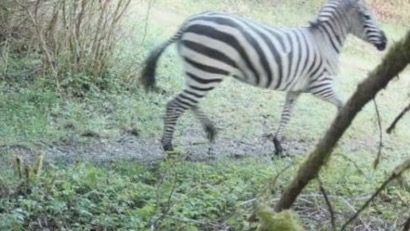
Tow truck operator and part-time horse trainer Dallas Clark is calling on locals and tourists from Seattle to keep away from the animal and allow it to calm down and get used to the feeding station so it can be recaptured. He is urging locals to keep their dogs on leash so that the zebra won’t get spooked and will continue to remain close to town. I don’t know how successful his efforts will be. You can’t keep people from trying to see a wild zebra in the mountains when you live so close to a city of 737,000 people. Swede’s Cafe probably appreciates the attention and the increased flow of customers. Just imagine how much fun it would be to see both Bigfoot and the zebra in a single outing. I might even brave Seattle Traffic, something I usually avoid, for that opportunity. However, Bigfoot might not spend the entire winter in the North Cascades. When the snow gets deep, the creature may venture south for a vacation. In June, 2018, a woman in Florida reported seeing Bigfoot in Florida. That’s a long walk from the North Cascades.
If you decide to come to visit us, keep your eyes open when crossing the mountains. You might catch a glimpse of a grizzly bear, or perhaps Bigfoot, and, if you are really lucky, you could see the black and white stripes of the North Cascades zebra.